
DJI Osmo Pocket 4P Lab Test: Rolling Shutter, Dynamic Range and Exposure Latitude

The new DJI Osmo Pocket 4P gimbal camera comes with a bold claim – 17 stops of dynamic range on the wide camera! Of course we couldn’t resist to verify these claims with our CineD lab test. And the unbelievable has happened – curious to hear more? Then read on …
Usually, with lab tests it’s more or less the same situation recently. A new camera arrives, the manufacturer claims some very high numbers for dynamic range and in the lab we test between 11.5 to 12.5 stops at a signal to noise ratio of two, and between 7 – 9 stops of exposure latitude. Sounds a bit boring, right?
Please read our article here about the launch and specs of the DJI Osmo Pocket 4P.
We have also just published our Lab Test of the Insta360 Luna Ultra. In case you missed it, check it out here.
With the advent of dual gain technology, where a high and low ISO are combined in one exposure, things started to change.
We saw this technology early on in state of the art cinema cameras like the ARRI Alexa lineup, and they can be found on top of our “best of charts”. More recently this technology has arrived in consumer cameras as well, like the Canon C70, the LUMIX S1II and GH6 / 7 and now also in the Sony A7R IV – accordingly, the gap between high end cinema cameras and consumer cameras became smaller.
Fast forward to today, we see another new technology in the Osmo Pocket 4P sensor in the wide camera called LOFIC (lateral overflow integration capacitor). This technology enables significant reserves in the highlights – confirmed by our tests below!

Despite the very interesting new sensor technology, we were hesitant to use our standard testing procedures, as the 20mm wide camera has to move very close to the Xyla21 chart for dynamic range testing, and then you get all sorts of reflections from the brighter patches of the chart impacting the darker areas – that’s far from optimal. Hence we moved the camera quite a bit (breaking the symmetry), and used some do-it-yourself flags until this part was OK. The same was true for the latitude test. Images are rather distorted as we are quite close to the subject.
Again my dear colleague Florian Milz was super helpful to figure out all the required modifications and he also helped to shoot and analyze this test!
Luckily though, the DJI OSMO Pocket 4P does not do some sort of computational scene dependent adaptions (like the iPhones 17 / 17 Pro are doing, preventing a proper lab test), hence the manual mode is truly manual and nothing else changes – hence, we’re all set to dive in!
In the following you will always see two results, one for the 1″ sensor 20mm equiv. wide LOFIC F2.0 camera, and one for the mid tele 60mm equiv. 1.28″ F1.8 camera.
Rolling shutter of the DJI Osmo Pocket 4P
As usual we use our 300Hz strobe light to reveal the pairs of black and white bars across the image.

The wide camera (in D-Log2) clocks a solid but not exceptional 11ms (less is better), also at the higher 60 frames per second mode. The mid tele camera (in D-Log) is a bit faster and shows 9.4ms.
From these results it becomes evident why higher framerates are only available in some different sort of sensor subsampling in the “normal” mode (e.g. 4K 200fps would require 5ms of rolling shutter).
Dynamic Range of the Osmo Pocket 4P
Let’s start with the 20mm wide camera, which features the new LOFIC technology and a new 10bit D-Log2 mode to accommodate the increase in dynamic range, with a native ISO of 1600. The mid tele is a standard sensor which features the standard D-Log profile and has a native ISO of 400.
If you are not aware how we test dynamic range, please head over here first.
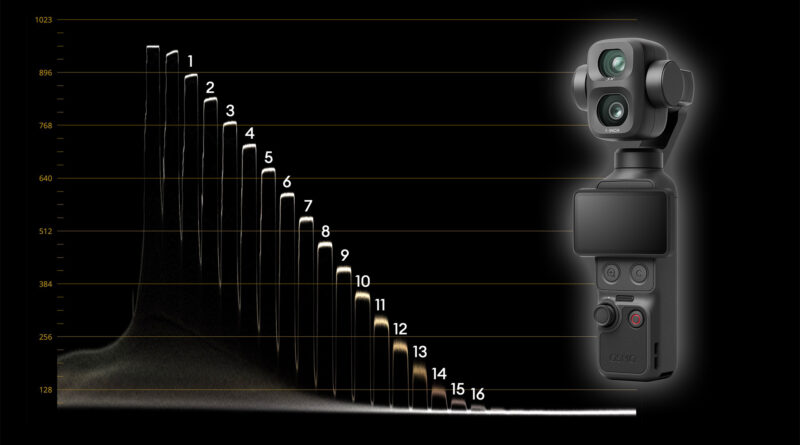
A shot of our Xyla21 chart in 10bit 4K 25p D-Log2 at ISO1600 reveals the following waveform:

We can identify 16 stops of dynamic range above the noise floor, with a faint 17th stop buried inside the noise floor. You can see that there are still some reflections which we weren’t able to fully avoid as the noise floor on the left side is a bit elevated. But life is all about compromise, right?
IMATEST reveals the following:

We get 16 stops at a signal to noise ratio (SNR) of 2, and 17.2 stops at SNR = 1.
This is really astonishing – the best result we ever saw since we test cameras! In the “noise spectrum” graph on the lower right hand side you can see very high amplitudes at high frequencies, which basically means it is a very detailed 4K image with little internal noise reduction!!
And now it comes – this is better than the results we got for the current leader in terms of dynamic range, the ARRI Alexa 35 (and, there is a factor of 100x in price between the two). All that for a 1 inch sensor size!
Now, the proof of the pudding will be the exposure latitude test below, let’s see what we get there and how it fares against the Alexa 35!
But before that, let’s have a look at the mid tele 60mm camera at ISO400 and again 10bit D-Log:

Aha, here we are back with the usual 12stops above the noise floor.

IMATEST reveals 11.6 / 12.9 stops at SNR = 2 / 1. Quite good for a 1.28″ sensor though!
Exposure Latitude of the DJI OSMO Pocket 4P
As stated in previous articles, latitude is a camera’s ability to retain detail and color when over- or underexposed and then pushed back to a base exposure. This test is very revealing, as it pushes the complete image pipeline of any camera to its absolute limits, not just in the highlights but mainly in the shadows.
Our studio base exposure is (arbitrarily) chosen as having an (ungraded) luma value of around 60% on the forehead of our subject on the waveform monitor – in this case, my dear colleague Nino:

As mentioned earlier, we had to move very close to Nino which leads to significant distortion. With the mid tele of course this looks normal again.
Now, let’s start to overexpose. Unfortunately, with our strongest studio light we were not able to come close to clipping the red channel on Nino’s forehead, hence here is the 4 stops overexposed image, pushed back to base:


Looking at the RGB waveform of the Xyla21 measurements before, there is a bit more than 1 stop headroom still in the red channel. Hence, we can overexpose more than 5 stops from our base exposure without clipping the forehead.
Now, let’s start to underexpose by doubling the shutter value until we are reaching 1/6400th, and then we also used NISI IRND’s at 0.3, 0.6, 0.9, 1.2 density (as the f-stops of the lenses are fixed).
Let’s directly move to 4 stops underexposure, brought back to base:

There is very little noise, the image doesn’t even require noise reduction. We are at 9 plus stops of exposure latitude! A value that was state of the art last year with the Canon R1, or Sony A9III, but also the RED camera lineup. Only then mid 2026 the Lumix S1II with the dual gain implementation was able to show 10 stops of exposure latitude, like the ARRI ALEXA Mini LF.
Hence, let’s have a look at 10 stops plus of exposure latitude:

This still looks quite OKish, but now a brownish cast is evident, and something else: there seems to be quite some vignetting in the 20mm lens which is corrected internally, as it was not visible so far. However, we are now digging into the shadows and the correction is not active anymore as it seems – a strong vignette is very evident.
Also, the noise removed 5 stops under image shows the limits of 10bit – posterization shows up. This is at the cusp of being usable (especially evident in the moving image):

Lets move on to 6 stops underexposure, pushed back:

Vignetting becomes very pronouced, as well as the noise. We are at 11 stops plus of exposure latitude! Let’s see if noise reduction can save this image:

Well no. The moving image reveals large blotches of chroma noise hovering all over the image, and colors become quite distorted – for example on the shadow side of Nino’s face. But still, no other artefacts like horizontal or vertical lines are visible which are hampering latitude results for other cameras!
Despite the good IMATEST score of the DJI Osmo Pocket 4P, the limits of a compressed 10bit codec are revealed. But let’s keep things in perspective, a solid 10 stops of exposure latitude with some wiggle room towards 11 is a superb result for such a tiny camera, unheard of before!
The leader of the pack in terms of exposure latitude is still the ARRI Alexa 35, which scored 12 stops of exposure latitude using 13bit ARRIRAW. At least, one top of the line cinema camera is able to surpass this new sensor ;-).
Now, looking at the 60mm mid tele lens & sensor combination, we can overexpose 3 stops from our base exposure before the red channel starts clipping on Nino’s forehead:

From here we underexpose to 4 stops below base, push back up and get the following image:

This still looks OK, although noise starts to creep in. We are at 7 stops of exposure latitude.
Let’s go to 5 under, pushed back:

This definitely requires noise reduction:

Using noise reduction this still looks sort of OKish, there are no artifacts like horizontal lines and also the colors hold up quite well. We are at 8 stops of exposure latitude. Also, the noise itself looks quite organic.
Moving to 6 under, pushed back we can see that the image breaks apart:

Also noise reduction cannot save this image:

In the moving image there are large blotches of chroma noise hovering around in the image, and even DaVinci’s AI Ultra Noise reduction algorithm cannot bring this back without loosing all details. Game over.
Hence, the mid tele camera manages to show 8 stops of exposure latitude – which is a really good result for such a tiny sensor! It is 2026 and there are consumer full frame camera’s out there that barely manage to reach this result!
Summary
The DJI Osmo Pocket 4P managed to surprise us on multiple levels. Already starting with the waveform of our Xyla21 chart, seeing 16 stops above the noise floor for the wide camera was a first for us. The IMATEST score confirmed this. However, the latitude test again put things a bit into perspective – a solid result of 10 stops of exposure latitude with a bit of room towards 11 is superb, but pushing further is not really possible due to the limitations of the 10 bit codec, as posterization starts to occur. There is a reason that ARRIRAW moved to 13bits of bit depth with the Alexa 35 (which reached a similar level of dynamic range) in order to exactly prevent this from happening. And the Alexa 35 scored 12 stops of exposure latitude accordingly.
But just the mere fact that we are comparing a sub 1K USD device with the Alexa 35 speaks for itself.
The 60mm camera doesn’t disappoint either, showing very up to date results with 8 stops of exposure latitude and 11.6 stops of dynamic range at SNR = 2.
All of that with rolling shutter values between 9.4 (60mm) and 11ms (20mm)? WOW, what a package!!
And thinking further, imagine a small camera body with a Micro Four Thirds lens mount hosting this new 1″ LOFIC sensor with internal RAW combined with all the speed booster options out there … similar to the original Blackmagic Pocket Cinema camera?
Have you shot with the DJI OSMO Pocket series, or even the new 4P? Please let us know in the comments section below!
Source link