
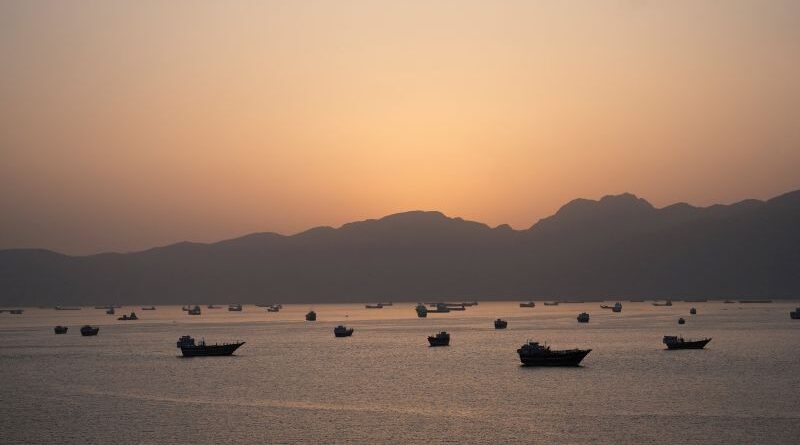
Iran eyes a new source of power deep beneath the Strait of Hormuz
Emboldened by its successful wartime blockade of the Strait of Hormuz, Iran is turning to one of the hidden arteries in the global economy: subsea cables beneath the waterway that carry vast internet and financial traffic between Europe, Asia and the Persian Gulf.
The Islamic Republic wants to charge the world’s largest tech companies for using the subsea internet cables laid under the Strait of Hormuz, and state-linked media outlets have vaguely threatened that traffic could be disrupted if firms don’t pay. Lawmakers in Tehran discussed a plan last week which could target submarine cables linking Arab countries to Europe and Asia.
“We will impose fees on internet cables,” Iranian military spokesperson Ebrahim Zolfaghari declared on X last week. Iran’s Revolutionary Guards-linked media said Tehran’s plan to extract revenue from the strait would require companies like Google, Microsoft, Meta, and Amazon to comply with Iranian law while submarine cable companies would be required to pay licensing fees for cable passage, with repair and maintenance rights given exclusively to Iranian firms.
Some of these companies have invested in the cables running through the Strait of Hormuz and the Persian Gulf, but it’s unclear if those cables traverse Iranian waters.
It’s also unclear how the regime could force tech giants to comply, as they are barred from making payments to Iran due to strict US sanctions; as a result, the companies themselves may view Iran’s statements as posturing rather than serious policy.
Still, state-affiliated media outlets have issued veiled threats warning of damage to cables that could impact some of the trillions of dollars in global data transmission and affect worldwide internet connectivity.
 www.submarinecablemap.com in May 14, 2026.” class=”image_large__dam-img image_large__dam-img–loading” onload=’this.classList.remove(‘image_large__dam-img–loading’)’ onerror=”imageLoadError(this)” height=”1237″ width=”1855″ loading=’lazy’/>
CNN has reached out to the companies mentioned in the Iranian report.
As fears grow that the war could resume following US President Donald Trump’s return from China, Iran is increasingly signaling that it has powerful tools at its disposal beyond military force. The move underscores the significance of the Strait of Hormuz beyond energy exports, as Tehran seeks to turn its geographic leverage into long-term economic and strategic power.
Subsea cables form the backbone of global connectivity, carrying the vast majority of the world’s internet and data traffic. Targeting them would affect far more than internet speeds, threatening everything from banking systems, military communications and AI cloud infrastructure to remote work, online gaming and streaming services.
Iran’s threats are part of a strategy to demonstrate its leverage over the Strait of Hormuz and ensure the survival of the regime, a core objective for the Islamic Republic in this war, said Dina Esfandiary, Middle East lead at Bloomberg Economics.
“It aims to impose such a hefty cost on the global economy that no-one will dare attack Iran again,” she said.
Several major intercontinental subsea cables pass through the Strait of Hormuz. Because of long-standing security risks with Iran, international operators have deliberately avoided Iranian waters, instead clustering the majority of the cables in a narrow band along the Omani side of the waterway, said Mostafa Ahmed, a senior researcher at the United Arab Emirates-based Habtoor Research Center, who published a paper on the effects of a large-scale attack on submarine communications infrastructure in the Gulf.
 www.submarinecablemap.com in May 14, 2026 showing cables traversing the Strait of Hormuz.” class=”image_large__dam-img image_large__dam-img–loading” onload=’this.classList.remove(‘image_large__dam-img–loading’)’ onerror=”imageLoadError(this)” height=”1267″ width=”1900″ loading=’lazy’/>
However, two of those cables, Falcon and Gulf Bridge International (GBI), run through Iranian territorial waters, said Alan Mauldin, research director at TeleGeography, a telecom research firm.
Iran has not explicitly said it will sabotage the cables, but it has repeatedly declared through officials, lawmakers and state-linked media of its intent to punish Washington’s allies in the region. It appears to be the latest asymmetric warfare technique devised by the regime to attack its neighbors.
Armed with combat divers, small submarines, and underwater drones, the Islamic Revolutionary Guard Corps (IRGC) poses a risk to underwater cables, Ahmed said, adding that any attack could trigger a cascading “digital catastrophe” across several continents.
Iran’s neighbors across the Persian Gulf could face severe disruptions to internet connection, potentially impacting critical oil and gas exports as well as banking. Beyond the region, India could see a large proportion of its internet traffic affected, threatening its huge outsourcing industry with losses amounting to billions, according to Ahmed.
The strait is a key digital corridor between Asian data hubs such as Singapore and some cable landing stations in Europe, Ahmed said. Any disruption could also slow financial trading and cross-border transactions between Europe and Asia, while parts of East Africa could face internet blackouts.
And if Iran’s proxies decide to employ similar tactics in the Red Sea, the damage could be far worse.
In 2024, three submarine cables were severed when a vessel struck by Yemen’s Iran-aligned Houthi militants dragged its anchor across the seabed while sinking, disrupting nearly 25% of internet traffic in the region, according to Hong Kong-based HGC Global Communications.
Even though the impact of damage to the cables could be high in the Middle East and some Asian countries, TeleGeography said “cables traversing the Strait of Hormuz account for less than 1% of global international bandwidth as of 2025.”
The first transatlantic telegram was sent through an undersea cable in 1858, carrying a 98-word congratulatory message from Britain’s Queen Victoria to US President James Buchanan that took more than 16 hours to arrive. The importance of undersea cables has grown exponentially since.
Today, a single optical fiber in modern submarine cables can carry data equivalent to roughly 150 million simultaneous phone calls at the speed of light, according to the International Cable Protection Committee.
The practice of disrupting underwater communication cables dates back nearly two centuries to the laying of the first telegraph cable in the English Channel in 1850. Among the opening acts of World War I, Britain severed Germany’s key telegraph cables, cutting off its communications with its forces.
Most modern cable damage results in minimal disruption because operators can quickly reroute traffic across the global network of subsea networks. Yet, any large-scale damage today would have far greater consequences than in the telegraph age, given the world’s near absolute dependence on data flows through these cables.
The ongoing war in Iran could also seriously complicate cable repair attempts as maintenance vessels must remain stationary for extended periods while fixing faults, experts say. Adding to the challenge, of the five maintenance ships that normally operate in the region, only one remains inside the Persian Gulf, according to Mauldin.
Iranian news outlets have framed the proposal to charge for subsea cables passing through its waters as compliant with international law, citing the 1982 United Nations Convention on the Law of the Sea (UNCLOS), which includes provisions governing submarine cables.
While Iran has signed but not ratified the convention, it is considered by the legal community as binding under customary international law. Article 79 of UNCLOS says coastal states have the right to establish conditions for cables or pipelines entering their territory or territorial sea.
Iranian media outlets have pointed to Egypt as a precedent. Cairo has leveraged the Suez Canal’s strategic location to host many subsea cables linking Europe and Asia, generating hundreds of millions of dollars annually in transit and licensing fees.
The Suez Canal, however, is an artificial waterway excavated through Egyptian territory, while the Strait of Hormuz is a naturally occurring strait governed by a different legal framework, according to an international law expert.
“Of course, for existing cables, Iran has to abide by the contract that had been made when the cable was laid,” Irini Papanicolopulu, a professor of international law at SOAS University of London, told CNN. “But for new ones, any state, including Iran, can decide if and under what conditions, cables can be laid in its territorial sea.”
Esfandiary, of Bloomberg Economics, said Iran “theoretically knew” it had leverage over the strait but was uncertain how significant the impact would be if it acted on those threats.
Now, she added, Tehran “has discovered the impact.”