
Trump says deal to reopen Strait of Hormuz could come as early as Wednesday
CAIRO (AP) — U.S. President Donald Trump said a deal on the Strait of Hormuz could come as early as Wednesday, as Iran and Oman inched toward an agreement to reopen the critical waterway and potentially help bring an end to the war.
Israel and the U.S. originally cited goals including toppling Tehran’s government and ending its nuclear program, but the war has devolved into a fight over the strait as Iran’s attacks and threats ground shipping to a halt.
Closure of the strait, through which a fifth of the world’s oil and natural gas once passed, has driven up the price of fuel and basic goods far beyond the region, roiling the global economy. Trump is also under mounting pressure to end an unpopular war ahead of midterm congressional elections scheduled for later this year.
Trump says deal to reopen strait is close
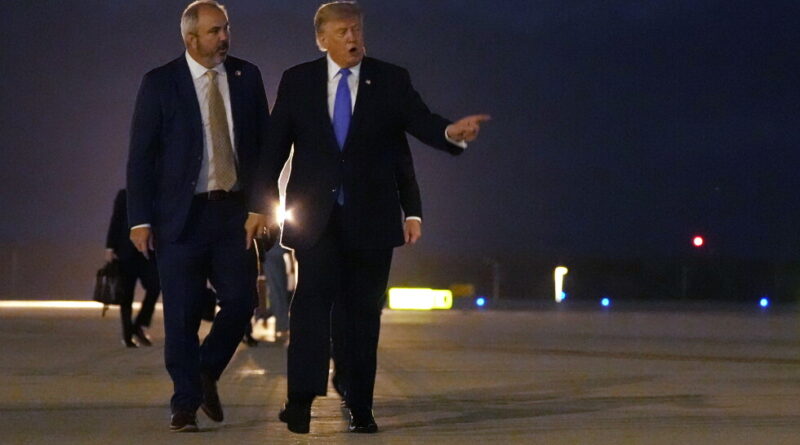
The U.S. president was asked by reporters traveling with him in California about a report on the Axios news site that an announcement on the Strait of Hormuz could be made on Wednesday.
“It could happen. Tomorrow or the next day,” he said, speaking on Tuesday evening California time. “A lot of progress has been made.”
Oil prices eased Wednesday on hopes of a deal that would allow shipping to resume. Brent crude, the international standard, slipped by 1.2% to $78.43 per barrel early Wednesday.
The U.S. and Iran reached a deal to open the strait in June, only for attacks to resume. In recent days, Trump has again alternately threatened massive strikes and voiced support for diplomatic efforts.
Ships attacked in Red Sea and Strait of Hormuz
Even as hopes increased that a deal on the Strait of Hormuz could be imminent, attacks on shipping in the region continued.
The Iranian-backed Houthi rebels claimed Wednesday they had fired ballistic missiles toward a Saudi oil tanker called the Wafa in the Red Sea. Brig. Gen. Yahya Sare, a military spokesman for the Houthis, made said in a pre-recorded statement that the vessel was targeted in the northern Red Sea off the Saudi port city of Yanbu. He didn’t provide evidence.
There was no immediate comment from Saudi Arabia.
The attack is part of a recent escalation between the rebels and Saudi Arabia which threatened to reignite the Yemen civil war four years after the two sides reached a de-facto truce. In July, the Houthis announced they were closing the Bab el-Mandeb Strait that leads to the Red Sea for Saudi-linked shipping in retaliation for the kingdom’s blockade on Yemen and an attack on the international airport in Yemen’s rebel-held capital, Sanaa.
On Tuesday, an Indian-flagged commercial ship sank in the Red Sea off Yemen after being struck by an explosive-laden boat, Yemeni and Indian authorities said. Yemen’s coast guard rescued the crew, which included 13 Indians and a Yemeni. There was no immediate claim of responsibility.
Earlier Tuesday, a cargo ship reported being “hit by an unknown projectile” while traversing the Strait of Hormuz, according to the United Kingdom Maritime Trade Operations Center.
The center said the reported strike damaged the vessel at around 2 a.m. local time, about 37 kilometers (23 miles) northeast of the Omani port city of Al Khasab. The British maritime security firm Ambrey said the ship sustained damage.
The agreement would see routes controlled by Iran and Oman, regional officials tell AP
The possible agreement emerging from talks between Iran and Oman calls for ships to enter the Persian Gulf through an Iranian-controlled route and exit through a route controlled by Oman, two regional officials told The Associated Press. Service fees would be charged for providing security and preserving the maritime environment, the officials said.
The officials spoke on condition of anonymity to discuss the sensitive negotiations.
The Trump administration has previously ruled out any deal that would give Iran control over the strait, which was an open international waterway before the U.S. and Israel attacked Iran on Feb. 28. About one fifth of the world’s oil and natural gas passed through the strait, but shipping through the waterway has been reduced to a trickle at best by Iran’s attacks since the start of the war.
In an exchange with reporters on Monday, the U.S. president reiterated his public opposition to tolls being charged in the strait. “I’m not going to let them charge,” Trump said. “Anybody’s going to charge, we’ll charge.”
The regional officials said negotiations are still underway and that the final agreement could take a different form, with any deal linked to lifting the U.S. blockade on Iran’s ports.
US and Iranian officials say progress is being made
Iranian Foreign Ministry spokesman Esmail Baghaei said Tuesday that Tehran’s talks with Oman were focused on “establishing safe inbound and outbound shipping lanes,” routes that “uphold sovereign rights while also addressing the national security considerations of both Iran and Oman.”
“The final results of these negotiations will be announced once concluded,” he added, according to Iran’s state-run IRNA news agency.
U.S. Secretary of State Marco Rubio confirmed progress had been made in those talks, “but not finality yet.”
Rubio has previously ruled out any deal that would give Iran control over the strait, saying last month that would create a “very dangerous precedent” for other parts of the world.
U.S. Treasury Secretary Scott Bessent told CNBC that “there is a chance we may have a deal today or tomorrow to open the strait and move towards a more normalized position in this conflict.”
Trump said Monday that the U.S. was in talks with Iran, saying it was Tehran’s “last chance” to reach a deal and avoid another U.S. military escalation. Iran has denied it is negotiating with the U.S., saying the talks are only with Oman.
“The first phase is the opening of the straits. The second phase will be the denuclearization,” Trump said. “And that will take a little while.”
___
Becatoros contributed from Athens and Superville contributed from Rancho Palos Verdes, California. Amer Madhani and Matthew Lee in Washington contributed to this report.