
16 Of The Coolest Ferrari Designs Of All Time
Choosing the coolest-looking Ferrari ever made might be the hardest car choice you can make. Ever since Enzo Ferrari transformed his racing team to also produce road-going cars in 1947, the Prancing Horse badge has featured on so many of the great performance cars that pushed the boundaries further than ever before. Starting with the 125 S, the cars released since then look pretty different, to say the least, but the core foundations of form and functionality haven’t changed.
Since the mid-20th century, Ferrari has experimented with so many different design philosophies that make the decision harder, but there are a few that manage to keep your eyes on them for a few seconds longer. Whether it’s with the early fastback-style GT cars that now fetch eye-watering prices, or the latest cutting-edge, aerodynamically adept track machines, here’s a look at 16 of the most iconic Ferrari designs that set it apart from any other manufacturer.
Ferrari Enzo
If you’re going to build a car to honor the founder of perhaps the most iconic performance brand ever, it has to be special. Fortunately, Ken Okuyama cut no corners when he was at the helm of Pininfarina, blending brutality and elegance seamlessly when creating the Enzo, which defines the idea of form following functionality.
Formula One was a huge inspiration point for the Enzo, which you can see just about everywhere. The giant nosecone not only makes a statement, but it also plays a crucial role in generating downforce by dispersing all the air from the radiators out of the two ducts and over the roof. Further back, the massive cooling inlets continue the functional style to maximise the effectiveness of the 660-horsepower 6.0L V12. At the rear, the Enzo relies on ground effect to keep the car stuck to the floor, helping to complete the low-slung, arrow-like form.
Ferrari 288 GTO
Going back another couple of decades to the 1980s, many of the most iconic Ferrari models used the same mid-engine design philosophy introduced by the 308 in 1975, a design that now defines the brand’s signature period. Out of all of them, though, the 288 GTO is undoubtedly the pinnacle of this style. Using the 308 GTB as the blueprint, the 288 GTO essentially looks like that car on steroids, with a much wider profile and a more aggressive aero focus.
The supercar’s extreme nature is solely due to its being built to meet homologation regulations for the Group B rally series, but the championship was canceled before it could take part in the planned circuit-racing iteration. The imposing wedged front end was more unique to the Ferrari, but the endless cooling vents/inlets, wide arches, and a flat rear design to channel air to the ducktail spoiler all scream ’80s rally in the best way. Pininfarina, of course, still ensured it looked like a Ferrari, retaining the sleek, exceptional proportions that the 308 gave us.
Ferrari 458 Speciale Aperta
A couple of years after the base 458 Italia was released, the pinnacle Speciale model became the last defining naturally aspirated V8 Ferrari. Designed as the performance-focused version of the base car, the 458 Speciale unsurprisingly prioritized downforce, with elements such as the hood dam, front bumper turning vanes and a more aggressive rear splitter alongside the active aero flaps.
But the ability to drop the car’s roof makes the lines of the Speciale look even better. Named the Aperta, the combination of the 4.5L V8, outstanding road dynamics, and open-air driving makes this car one of the most desirable modern Ferraris, with recent examples selling for over $1.6 million at auction. When the hardtop is retracted, the two pillars on either side of the flat engine cover complement the Speciale’s natural curves, making it a touch more spectacular than the standard Speciale.
Ferrari 250 Testa Rossa
The Testa Rossa marquee has been used only a few times by Ferrari. The most recent example is the new 849, with the ’84 Testarossa being another one of the most iconic GT cars from that period. However, going back to the first car to use the Testa Rossa name in 1957 gets you to the definition of elegance, pushing the barchetta philosophy as far as it can go. Built to replace the 500 TR in response to a change in engine regulations, Ferrari didn’t just heavily modify the V12 but also opted for a radically different aero package as well.
Sergio Scaglietti didn’t completely change the 500 TR’s silhouette, but the front end was heavily redesigned to help with cooling. Chunks of the bumper on either side of the grille were removed to direct air to the brakes, creating the staple pontoon-style fenders that stretch over the wheels. This also leads to the giant gaps behind the front wheels, sending all the air back out as efficiently as possible. While later racecars opted for a closed-fender design for better overall stability, the 250 Testa Rossa will always be one of the most distinctive cars to ever come from the Prancing Horse.
Ferrari 430 Scuderia
While the more aggressive, angular design style carried over from the 1980s into the ’90s with cars such as the 348 and 512, the 360 marked a major shift for Ferrari that set the stage for the decade of subsequent releases. Embodying smooth curves to the fullest, it quickly became one of the most elegant mid-engine sports cars around. Five years later, the F430 came in as a replacement, retaining the foundations of the 360 but bolstering its shape with a bit more aggression.
At the end of the body style’s run, the 430 Scuderia was the brand’s ultimate sports car at the time, lauded as a brilliant driver’s machine while looking the part. Once again, there weren’t any major changes to the base F430, but the bold use of exposed materials, particularly on the tweaked rear fascia, perfectly blends hard lines with the natural smoothness this body style produces.
Ferrari 410 Superamerica
Ferrari was already well established as one of the most desirable brands in the industry by the ’50s, and to capitalize on the demand for exclusivity, it built the incredibly limited 410 Superamerica in 1956. Instead of offering the same car to everyone, these were coach-built cars, which, despite many sharing the same base style, owners could customize many aspects of their 410s.
The Series I was easily one of the most luxurious cars Ferrari had built at the time, being aimed at the wealthiest clients in the book. While the Series II and III models shortened the wheelbase, the 250 GT-esque base design remained, combining one of the smoothest Ferrari philosophies with extra touches of boldness that set them apart. Pininfarina designed the car’s core foundations, as well as the spectacular Superfast editions. Still, other coachbuilders, such as Scaglietti, also designed one with unique tail fins on the back, a nod to the cars dominating America at the time.
Ferrari F40
The F40 is, without question, one of the most important cars in Ferrari’s history. For one, it was the final car to be signed off by Enzo himself, marking the end of an era not only for the brand but for the industry as a whole. Looking at it, you can spot some similarities between the F40 and the 288 GTO (particularly the Evoluzione version). But instead of being engineered for rallying, this supercar was built for the sole purpose of being the ultimate driver’s machine, sacrificing everything that didn’t make it faster.
While the 4.0L V8 more than played its part in making the F40 the fastest car of the decade, Pininfarina went all out to ensure it was as aerodynamically efficient as possible. This led to a far more imposing wedge-shaped front end compared to prior Ferraris, which was the defining element of the F40’s iconic wide, boxy look. NACA ducts can be found throughout to draw air to crucial components without disrupting the aero profile created by the low-slung, angular body. To finish it off, the massive fixed rear wing completes the outline, perhaps the most important element, making the car so distinctive.
Ferrari 250 LM
Ferrari’s ventures into mid-engine territory began at the start of the 1960s with the 246 SP. Over the next couple of years, the manufacturer continued to develop its new mid-engine philosophy, culminating in the 250 line in 1963. The open-top prototype (250 P) was incredibly successful, and the domination was intended to carry over to the GT category with the 250 LM. However, the FIA blocked it from racing, meaning it was technically a prototype. And still, it was mighty quick against the fastest cars on the track.
While capturing wins, it introduced people to the future of Ferrari’s design philosophy. Of course, the front-engined cars didn’t stop, but a new door was opened. Still retaining the same sort of curvature that Ferrari was best at, the cockpit being brought forward helped achieve the more athletic look, with beefy rear arches flanking the flat engine cover. Function is just as important as form with the 250 LM, which has massive inlets on the arches to direct air to the V12.
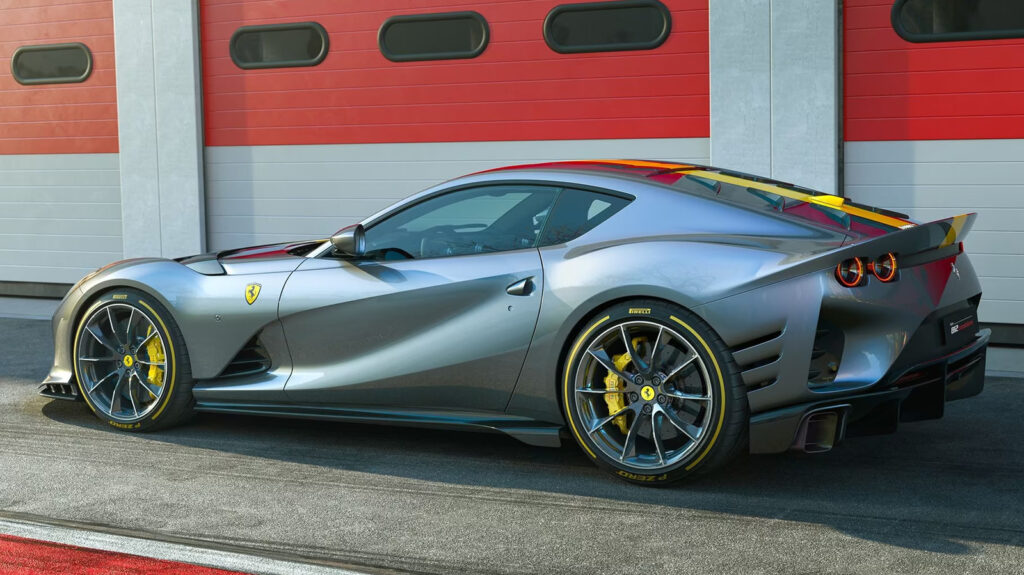
Ferrari 812 Competizione
Regarding the front-engine Ferraris, these cars have been a staple in the line-ups ever since the original 166 Inter days. While the rest of the 20th century gave us some pretty special machines, the front-engine V12 cars built this century have consistently found themselves at the top of the GT segment. The F12 broke new ground in 2012, but the 812 Superfast offered more power and a tweaked, refined design.
The base Superfast enhanced the natural dimensions of the long-nosed F12, but in the Competizione (the effective send-off for the car), Ferrari pushes the philosophy as far as it can go. Power was turned up to a thunderous 819 horsepower, but the aerodynamic additions deserve just as much focus. On the hood, a massive carbon fiber blade stretches from edge to edge. Also, instead of a rear window, Ferrari uses vortex generators to direct air to the larger ducktail spoiler, which flows seamlessly with the side design to fully connect every aspect of the car.
Ferrari 250 California
There are two main cars that define Ferrari’s excellence in the 1950s. One being the 250 GTO, and the other being the 250 California. Both have their advantages, but if we’re talking about the car with the most class and elegance, the latter may have beaten every other Ferrari in history. To expand the brand’s reach in the U.S., Ferrari decided to take the already-stunning Berlinetta version of the car and tasked Scaglietti with making it look just as good with no roof. The result is still widely considered the ultimate open-top Ferrari.
The stretching, pontoon-style front fenders down to the headlights, combined with the wide, curved egg-crate grille, is the pinnacle of simplistic beauty, but removing the fastback roofline from the Berlinetta essentially levels out the silhouette of the car, giving the rear arches even more definition. This one change perfectly highlights the car’s lower proportions, making it quite difficult to look away. The same can be said for its value, with some examples approaching $20 million.
Ferrari Daytona SP3
Moving forward to the newer icons for the Ferrari brand, it’s safe to say some nameplates haven’t had the same impact as the supercars of old. The record-setting F80 split the fanbase down the middle, with its much more modern, cutting-edge philosophy not to everyone’s taste. However, one car sure to help define the current era of the Prancing Horse is the Daytona SP3, which calls back to Ferrari’s heritage in the most striking way.
The Daytona SP3 fits within the mid-engine V12 lineage, not replacing anything but built solely to honor the success the racing team saw in the ’60s. It fits well within the forward-thinking design style that Ferrari is currently using, but the inspired proportions of the 330P/4 make the sleek curves and strong edges work effortlessly. Like the iconic ’60s racecar, the SP3 puts downforce at the forefront, with the rear sitting higher than the front, and an ultra-aggressive side profile in between the bulging arches. But from the rear, the dramatic slats aren’t just for show; they are also a clever way to dissipate heat from the 828-horsepower V12.
Ferrari 599 GTO
The 575M was the first front-engine Ferrari released in the 21st century, but it was the 599 GTB that truly broke the mold, moving away from the more angular body shape the brand often used in the ’90s for its GT cars. For the 599, Ferrari fully embraced curvature, connecting the stable long hood to the rear with mostly undisturbed connecting lines. The rear quarter still resembles the car it replaced, but is a little more rounded off.
The GTO model adds a few things that don’t change anything fundamental, but add a little more cool factor to the car. It uses a mesh grille similar to the 599XX, with a more angular front fascia. The dual air vents on either side of the V12 are also split up into four sections to add another subtle touch of aggression. At the rear, the changes are certainly more noticeable, with a more defined lip spoiler and new vents on the bumper. And what’s almost a staple with performance-enhanced Ferraris is that the rear splitter dominates the bottom third.
Ferrari 166 MM
Going way back to 1948, that year saw the unveiling of one of the most crucial cars in Ferrari’s history. This is none other than the 166 MM (named after the Mille Miglia), which kick-started the open-top, or Barchetta design style that the brand would use on so many nameplates in the next couple of decades. Hence the name, the 166 MM was engineered specifically to dominate road races, stripping back a lot of the features that the larger, more road-focused 166 Inter came with.
What was left is still one of the cleanest-looking Ferraris ever made. Coachbuilder Touring very evidently wants to create a car that cuts smoothly through the air, making the 166 MM the embodiment of curvature. There isn’t really a single solid, straight line on the car, aside from the trim reaching from the front arch to the classic bulging rear arch. It’s a masterclass in how undisturbed flowing lines can be such a treat to look at.
Ferrari LaFerrari
Replacing the Enzo was always going to be a monumental challenge for Ferrari, as they pretty much made the perfect, ground-breaking hypercar. Luckily, the brand somehow managed to fill its shoes and then some with the wonderfully-named LaFerrari. Ferrari didn’t actually deviate too much from the Enzo’s philosophy, instead creating a similar car design, drawing on all the knowledge gained over the 10 years between them.
The LaFerrari’s angular front end is more reminiscent of the Enzo than of the same wedge design. Hard lines still direct airflow to the middle of the front bumper, but the hood’s center drops to make way for the statement air vent. Pontoon-style arches still span the front wheels and connect seamlessly to the bottom half of the highly aggressive side design, which is engineered to direct air directly into the vent in front of the rear wheels. Being mid-engine, the bare-bones rear engine sits higher than the front to complete the perfectly executed rake design.
Ferrari F50
Similar to the F40, the F50 was built as a road-going racecar, leaning even further into F1 technology to achieve that. Coming from the incredibly harsh, boxy design of the F40, the F50’s smooth, flowing lines certainly made it look less brutal, but 30 years later, with less need to compare them, we can appreciate the F50 as a beautiful car in its own right. Its value also shows how people have warmed to it over the years.
This is another Ferrari where you’ll struggle to find a straight edge, aside from the dividing line running down the door at the same raked angle as the rest of the car. Honing in on the rake philosophy allows the fixed rear wing to make even more of a statement. It was also an open-top supercar, which meant bringing the cockpit forward, making the connecting wing even more dramatic. The front end is subsequently shorter than the F40, but the two massive air vents give it plenty of character without being obnoxious.
Ferrari 250 GTO
The 250 GTO is without question in the pantheon of automotive legends. Built to take Ferrari’s dominance in the GT racing category to new territory in place of the standard 250 GT. The job of turning the 250 GT into the GTO was given to Scaglietti, who revised just about every aspect of the aerodynamic package.
The front end drops much lower than the GT to reduce drag as much as possible, and also features the distinct triple intakes that send air into the Colombo V12. Overall, the front fascia is more rounded off, with no lines breaking it up, which is also the case for the rest of the 250 GT. The fastback roof design was also more curved than the GT’s, creating a steeper drop-off to the flat, sliced rear. Of course, it’s not an early ’60s Ferrari without its huge arches, which curve down to the very end of the car. Not only does it significantly improve airflow, but it also looks pretty spectacular.