
Fear grows as xenophobia spreads in South Africa : NPR

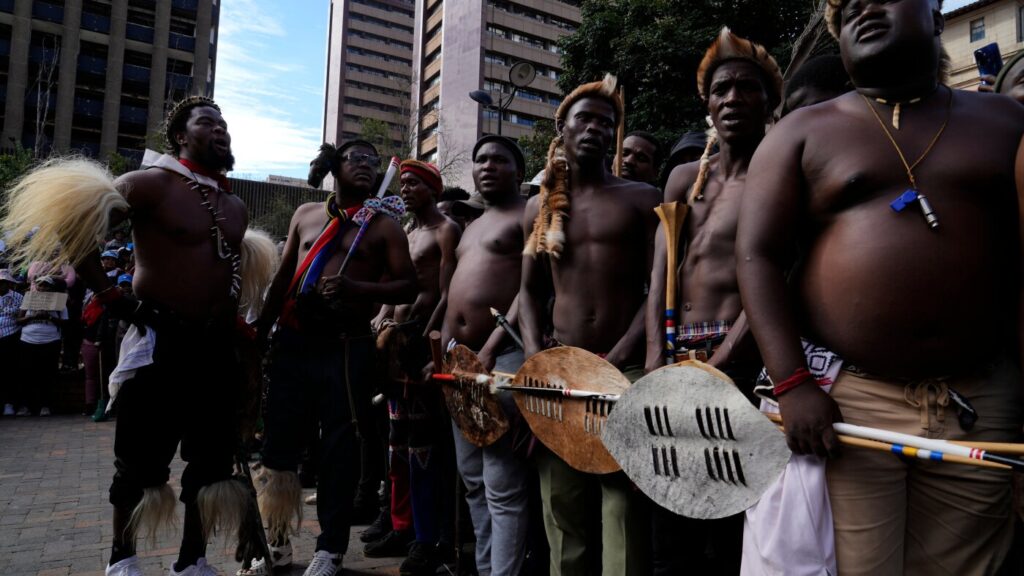
South Africans dressed in traditional attire protest against illegal migration on April 29 in Johannesburg.
Themba Hadebe/AP
hide caption
toggle caption
Themba Hadebe/AP
Johannesburg has always been a melting pot. Traverse South Africa’s economic capital and you’ll come across Zimbabweans trained as doctors but driving Ubers, Ethiopians running bustling restaurants, and Congolese selling colorful wax print fabrics.
Some of these immigrants have lived here for years. Others have recently arrived, seeking a better life in one of the continent’s richest and most stable democracies. Some are here legally, others not.
But all of them are now under threat — not just in Johannesburg but across the country, from Durban to Cape Town — as South Africa is engulfed by a rising tide of xenophobia.
For months now, mobs of anti-immigrant protesters, many brandishing sticks, have been marching through the streets chanting “Mabahambe” — a Zulu phrase meaning “They must go.” Some of them claim to perform “arrests” and say they have the right to check immigration papers, although they have no legal authority to do so.
Foreign-owned businesses have been attacked, people chased from their homes, and several migrants have been killed. In Durban, it’s a tinder keg, and thousands of Malawians who have fled their homes to escape the violence have camped out in the open, in winter, begging their country to send buses to rescue them.
In Cape Town, hundreds of Zimbabweans also camped outside their consulate. Nigeria, Ghana and Mozambique weren’t waiting — they’ve already repatriated those citizens who wanted to leave.
They’re right to be scared. In 2008, xenophobic riots left more than 60 dead — some burned alive by mobs — and tens of thousands displaced. There were deadly riots again in 2019. This year, so far, a Malawian and several Mozambicans have been reported killed.

South Africans in Johannesburg protest against illegal migration on April 29.
Themba Hadebe/AP
hide caption
toggle caption
Themba Hadebe/AP
The main xenophobic movement leading the charge this time is called March and March. It’s led by a media-savvy former radio presenter from Durban named Jacinta Ngobese-Zuma. NPR contacted her for comment, but she did not reply by date of publication.
“South Africa will be great again. It just needs all of us to rise and defeat our enemy,” she said at one recent press conference.
There are also established political parties that have jumped on the xenophobia bandwagon, anti-immigrant vitriol is all over TikTok, and fake news is spreading like wildfire on social media.
March and March has given all illegal immigrants in South Africa until June 30 to leave the country, an arbitrary date, and they have not specified what will happen when it passes.
Scapegoats for economic woes
All these groups blame immigrants for “stealing jobs.”
South Africa’s official unemployment rate is one of the worst in the world at over 30%, with youth unemployment at over 60%. They also blame the country’s high crime levels on foreigners.
But the data shows neither problem can be blamed solely on immigration, but rather years of economic stagnation and government mismanagement.

Displaced migrants queue at a deportation site in Durban, South Africa, on June 17.
AP
hide caption
toggle caption
AP
South Africa’s President Cyril Ramaphosa has tried to calm tensions, but the xenophobic feeling here is so entrenched now that he’s walking a fine line between condemning any violence and capitulating to some of their demands.
He has promised to strengthen the borders, crack down on undocumented immigrants and those employing them, and address the genuine economic challenges facing South Africans.
“We recognize that many communities are frustrated by crime, unemployment and pressure on public services. …The roots of these challenges lie primarily in inequality, slow economic growth and weaknesses in service delivery,” he said in a recent address.
“Addressing these challenges requires practical solutions, not the scapegoating of vulnerable people.”
But migrants from numerous countries who NPR spoke to in Johannesburg say the government warnings may be too little too late, and they fear what will happen come June 30.
Living in fear
In Jeppestown, a rundown suburb east of Johannesburg’s city center and a hotspot of violent crime, the pavements are litter-strewn and abandoned buildings house squatters and makeshift businesses. There are panel beaters, scrap metal sellers, upholsterers.
In one of these buildings, a group of men — mainly Malawians and Zimbabweans — are hard at work in a carpentry and upholstery workshop. One of them, a 25-year-old Malawian carpenter who asked to be identified only by his first name, Guy, because he fears for his life, says he came to South Africa three years ago in search of a better life. Malawi is among the world’s poorest countries, and many leave in hopes of improved opportunities.
He’s worked hard, scraped a living, but it’s been a constant battle with police — who he says regularly come by asking the men for their papers, and if they don’t have the right to be in South Africa, hit them up for bribes.

Malawian migrants sit on a driveway ahead of their deportation at a temporary center in Durban, South Africa, on June 19.
Themba Hadebe/AP
hide caption
toggle caption
Themba Hadebe/AP
Now, he says there’s the new threat from March and March protesters. He fears they could kill him, and he is considering going back to Malawi. Sandile Mbuyazi, an 18-year-old Zimbabwean also at the workshop, agrees but says he can’t return to his country, which has myriad economic and political problems.
“I’m scared because I don’t have a choice. They can kill you. I’m scared of these people,” he said of March and March.
Another Zimbabwean, 55-year-old upholsterer Victor Sithole, came to South Africa decades ago.
“We’re all scared. I’ve got quite a lot of friends who’ve been affected. Their homes have been destroyed, their businesses, so we don’t know what tomorrow brings to us,” he tells NPR, while eating his lunch — sold by a fellow Zimbabwean vendor — on the sidewalk.
He has a resident’s permit, he says, but doesn’t believe that will protect him if the xenophobic groups who’ve been marching in the area pass by. He likens South Africa to a conflict zone.
“Remember that when there’s war, they don’t choose who are you. War is war, so you have to just be careful no matter what. They’re not talking about papers, they’re talking about the foreign people … they say go back to your country.”
But Sithole says South Africa is his country: “I came here when I was 22 years, so part of my life it’s here, it’s part of my country.”
Walking down the road, Ghanaian Kofi David, who runs a business selling West African produce, stops to say he’s scared too, especially seeing what people are saying on social media. He says personally he thinks the hatred stems from jealousy, because often migrants run thriving businesses.
“Maybe it’s envy because some people if they see you are progressing and them, they’re not progressing.”
“To me, I feel like it’s politics,” he adds, noting South Africa holds local elections in November, and things might calm down after that.
“Like a war zone”
In a small flat in the nearby inner-city suburb of Yeoville, Bona Mapezi Bahati, 33 and eight months pregnant, sits with her 5-year-old daughter near a framed photograph of the Virgin Mary, which has become a small shrine set with offerings.

South Africans in Johannesburg protest against illegal migration on April 29.
Themba Hadebe/AP
hide caption
toggle caption
Themba Hadebe/AP
Mapezi arrived in South Africa as a teenager 15 years ago, having fled the Democratic Republic of Congo after being gang-raped by members of a militia in the country’s East. Initially, she says, she managed to get a six-month asylum seeker visa, but that’s long expired and she’s in bureaucratic limbo.
Now, she’s says, there’s the new threat of xenophobia.
“They tell me to go back to my country. I can’t. I still remember what happened to me … My kids are scared. I’ve told them if the protesters come, you must run away and hide because there’s nothing I can do.”
She’s been turned away from clinics too, which now have anti-immigrant protesters outside and where staff refuse to treat foreigners without papers or money. She doesn’t know where she’ll give birth.
“I feel so sad, especially as I’m pregnant, I’m scared they’ll kill me,” she says, struggling to hold back tears. “It’s like I’m in Congo. I feel like it’s a war zone here.”