
House Democrat calls for congressional hearings on Trump administration’s nuclear deal with Saudi Arabia – US politics live | US foreign policy
Hearing echoes of US military support for Shah of Iran, Democratic congressman calls for hearings on Saudi nuclear deal
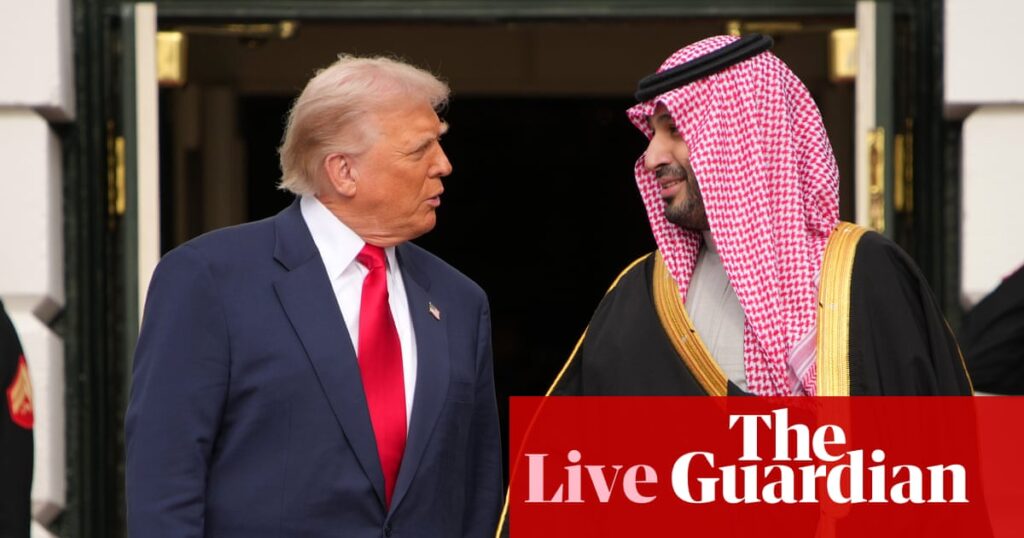
At House foreign affairs committee hearing on Wednesday, congressman Brad Sherman, a Los Angeles Democrat, called for an oversight hearing of the Trump administration’s nuclear cooperation agreement with Saudi Arabia, suggesting that exporting that technology could be as big a mistake as having armed the Shah of Iran in the 1970s.
“There are those who think that the Saudi possession of nuclear technology is totally benign, but I’ve been involved in this for a long time, and I remember when the most powerful monarch in the Middle East was a good friend of America. And the Shah got his hands on important US military technology. Thank God, nothing nuclear,” Sherman said while questioning Mike Waltz, the US ambassador to the UN, and former national security adviser to Donald Trump.
“Everything the Shah had in 1978 was in the mullahs’ hands in 1979,” Sherman said, referring to the Islamic revolution that toppled the Iranian monarch and brought the theocratic regime to power. “We have no idea who is going to be running Saudi Arabia 10 years from now.”
Sherman went onto point out that, in 2018, he and then-senator Marco Rubio had introduced the “No Nuclear Weapons for Saudi Arabia Act” which would have required approval from Congress before the US could enter into a civilian nuclear cooperation agreement with Saudi Arabia, and a Saudi investigation into the death of journalist Jamal Khashoggi – whose murder the same year in Turkey US intelligence later determined had been approved by the Saudi crown prince, Mohammed bin Salman.
Sherman argued that Congress should approve the deal only if it has what he called later “the same gold-standard safeguards as our deal with the UAE,” referring to a similar agreement with the United Arab Emirates struck in 2009, in which the UAE voluntarily committed to nonproliferation and agreed to not pursue domestic uranium enrichment and reprocessing.
“Is there any reason we should be bombing Iran because they won’t agree to limit their nuclear program while telling Saudi Arabia we give them the green light and they don’t even have to agree to these additional inspections?” Sherman asked Waltz.
After Waltz argued that US resolutions calling on Iran to not develop nuclear weapons provided a pretext for the current US-Israeli war on Iran, Sherman suggested there was “great hypocrisy here.”
“Saudi Arabia is not agreeing to the additional inspections that could make sure that their program is not used … to develop a nuclear weapon,” the congressman said, based on press reports of the terms of the agreement that has not yet been shared with Congress.
“I predict someone will introduce a resolution of disapproval and I invite members of this committee who have worked with us to prevent nuclear weapons in the Middle East, from non-democratic countries, to join in that effort,” Sherman said, in an oblique reference to the open secret that one nation in the region, Israel, does have nuclear weapons.
Key events
UAE agreed not to enrich uranium in nuclear deal with Obama; will Trump’s deal with Saudis be different?
On its face, the nuclear cooperation agreement, commonly known as a 123 agreement (after the relevant section of the US Atomic Energy Act) signed on Wednesday by the Trump administration and Saudi Arabia looks similar to an agreement signed in 2009 by the Obama administration and the United Arab Emirates.
However, until we see the text, it is not clear if the deals are alike in one key way: whether or not the Saudis have agreed, as the UAE did, to safeguards that would block the kingdom from developing nuclear weapons.
In the UAE deal, first negotiated during the Bush administration, and then reworked and signed by the Obama administration on 21 May, the Emirates agreed to accept the International Atomic Energy Agency’s so-called “additional protocol”, which allows the agency to verify the peaceful use of all nuclear material, and affirmed its commitment “to pursue a renunciation of the development of domestic enrichment and reprocessing capabilities in favor of long-term commitments for the secure external supply of nuclear fuel”.
“In signing this Agreement, the UAE has demonstrated its commitment to develop civil nuclear energy responsibly, in full conformity with its nonproliferation commitments and obligations,” the Obama state department wrote in a 2009 fact sheet. “Among those is the UAE’s commitment not to pursue enrichment and reprocessing (ENR) within its territory, representing a marked contrast to Iran which has failed to comply with its international obligations.”
Initial reports on the terms of the Trump administration’s deal with Saudi Arabia suggest that it could allow for uranium enrichment in Saudi Arabia, opening a potential pathway to the production of nuclear weapons in the kingdom.
“The deal breaks from the ‘gold standard’ of nonproliferation, which would prohibit domestic uranium enrichment and plutonium reprocessing,” the Wall Street Journal editorial board argued on Wednesday, under the headline: “Saudi Nuclear Enrichment Is a Mistake”.
The Journal’s editors went on to suggest that Trump’s Saudi nuclear deal will have weaker safeguards than the Bush-Obama UAE nuclear deal:
The next best way to prevent nuclear proliferation is with inspections and monitoring, but the Trump deal weakens those, too. The tried-and-true method is the International Atomic Energy Agency’s Additional Protocol. The United Arab Emirates signed up for it, along with the gold standard of no domestic enrichment, as a condition of its 2009 nuclear deal negotiated largely with George W. Bush. But now the Saudis have been allowed to reject the Additional Protocol and receive U.S. support all the same.
The Trump Administration says it has devised a bilateral safeguards agreement of its own. But we doubt the Saudis rejected the standard protocol in favor of even stricter inspections. They are bound to be weaker, establishing the precedent that each U.S. ally can push for its own preferential monitoring.

George Chidi
Donald Trump scoffed at the word “affordability” as a political message, describing it at a campaign rally on Wednesday as a term concocted by Democratic political consultants to criticize his presidency. Yet even as the president dismissed the notion of affordability, he devoted much of his speech at Wheeler high school to touting the bread-and-butter benefits of his economic policies.
“So I just want you to remember that if you’re paying a little bit more – a lot of it’s come down now, we got it coming down very rapidly actually,” Trump said in Marietta, an Atlanta suburb, casting higher prices today as a lingering effect of the Biden administration.
Americans are broadly disappointed with Trump’s handling of the economy, with just 33% of voters approving in a recent Washington Post-Ipsos poll, an assessment that could hurt his party’s hopes of bucking historical precedent and retaining control of Congress in November’s midterm elections.
Bernie Sanders calls deal to provide nuclear technology to Saudi Arabia ‘absurd’
Senator Bernie Sanders, a Vermont independent, expressed strong opposition to the Trump administration’s deal to help Saudi Arabia enrich uranium for nuclear energy, a capability that could open the door to the repressive kingdom developing nuclear weapons.
“Trump claims his war on Iran is about stopping an authoritarian country from enriching nuclear fuel,” Sanders wrote on social media. “Now he’s letting his best friends in Saudi Arabia — one of the most brutal dictatorships in the world — do exactly that. This is absurd. No nuclear for the Saudi dictatorship.”
Hearing echoes of US military support for Shah of Iran, Democratic congressman calls for hearings on Saudi nuclear deal
At House foreign affairs committee hearing on Wednesday, congressman Brad Sherman, a Los Angeles Democrat, called for an oversight hearing of the Trump administration’s nuclear cooperation agreement with Saudi Arabia, suggesting that exporting that technology could be as big a mistake as having armed the Shah of Iran in the 1970s.
“There are those who think that the Saudi possession of nuclear technology is totally benign, but I’ve been involved in this for a long time, and I remember when the most powerful monarch in the Middle East was a good friend of America. And the Shah got his hands on important US military technology. Thank God, nothing nuclear,” Sherman said while questioning Mike Waltz, the US ambassador to the UN, and former national security adviser to Donald Trump.
“Everything the Shah had in 1978 was in the mullahs’ hands in 1979,” Sherman said, referring to the Islamic revolution that toppled the Iranian monarch and brought the theocratic regime to power. “We have no idea who is going to be running Saudi Arabia 10 years from now.”
Sherman went onto point out that, in 2018, he and then-senator Marco Rubio had introduced the “No Nuclear Weapons for Saudi Arabia Act” which would have required approval from Congress before the US could enter into a civilian nuclear cooperation agreement with Saudi Arabia, and a Saudi investigation into the death of journalist Jamal Khashoggi – whose murder the same year in Turkey US intelligence later determined had been approved by the Saudi crown prince, Mohammed bin Salman.
Sherman argued that Congress should approve the deal only if it has what he called later “the same gold-standard safeguards as our deal with the UAE,” referring to a similar agreement with the United Arab Emirates struck in 2009, in which the UAE voluntarily committed to nonproliferation and agreed to not pursue domestic uranium enrichment and reprocessing.
“Is there any reason we should be bombing Iran because they won’t agree to limit their nuclear program while telling Saudi Arabia we give them the green light and they don’t even have to agree to these additional inspections?” Sherman asked Waltz.
After Waltz argued that US resolutions calling on Iran to not develop nuclear weapons provided a pretext for the current US-Israeli war on Iran, Sherman suggested there was “great hypocrisy here.”
“Saudi Arabia is not agreeing to the additional inspections that could make sure that their program is not used … to develop a nuclear weapon,” the congressman said, based on press reports of the terms of the agreement that has not yet been shared with Congress.
“I predict someone will introduce a resolution of disapproval and I invite members of this committee who have worked with us to prevent nuclear weapons in the Middle East, from non-democratic countries, to join in that effort,” Sherman said, in an oblique reference to the open secret that one nation in the region, Israel, does have nuclear weapons.
George Chidi
At a Donald Trump event in Marietta, Georgia, the state’s Republican candidate for governor Rick Jackson pledged to ask the Georgia legislature to match the $1,000 federal contribution to childhood Trump investment accounts, and if they failed to do so, would match the figure himself.
“Here in Georgia, we should not stope with $1000,” Jackson said. “I believe our legislature will approve that. If they don’t I will personally donate it myself.”
Jackson is the founder of Jackson Healthcare, a medical staffing company. His personal net worth has been estimated to be more than $3 billion.
In 2024, the state of Georgia recorded a bit more than 126,000 live births, which equates to $126 million in annual contributions for Trump accounts. Georgia began the 2026 fiscal year with an unprecedented budget cushion of about $15 billion in the bank, with $9 billion in unrestricted funds. This surplus resulted from conservative budgeting that began in 2021 as a reaction to pandemic pressures. That money has become an intense political question, with Republicans looking for ways to provide property tax relief while Democrats arguing for a broader investment in health care and child care support.
As the US strikes again targets in Iran in retaliation for that nation’s blockade of the strait of Hormuz, Iran-backed Houthi rebels in Yemen claim to have attacked two Saudi oil tankers for violating a blockade near the Bab el-Mandeb Strait, a chokepoint for oil exports transiting the Red Sea.
Saudi Arabia, which borders Yemen, led a military intervention in 2015, triggering a year-long civil war to prop up Yemen’s Saudi-backed government.
The United Kingdom Maritime Trade Operations Centre said in an alert issued on Wednesday night it “has received a report of an incident 70NM southwest of AL SHUQAIQ, Saudi Arabia. The Master of a tanker reports being struck by an unknown projectile which has caused a fire onboard that the crew are currently fighting.”
Senator Chris Murphy, a Connecticut Democrat, responded to news of the Houthi attacks by writing on social media: “Everyone saw all of this coming. This chaos was totally foreseeable and Trump chose to start this war anyway.”
Trump boasts about helping defeat Jon Ossoff in 2017 special election, fails to mention his role in Ossoff’s Senate win in 2021
During his 75-minute address to supporters in Georgia on Wednesday, Donald Trump took some time out from boasting about what he calls his many accomplishments to attack Jon Ossoff, the incumbent Democratic senator whose withering criticism of the president has thrilled Democrats and led to calls for Ossoff to mount a 2028 presidential campaign, should he first win his reelection bid in November.
“I fought Ossoff before, as you know, and we won. We had a great success against this guy,” Trump said, fondly recalling his role in Ossoff’s narrow loss in a 2017 special election in Georgia’s sixth congressional district, in what was then a Republican-dominated Atlanta suburb.
“He reminds me of Pinky Herman,” the president said. “Do you ever see Pinky Herman?” Trump asked, a comment that prompted some laughter from his supporters in the hall, and a scramble, among journalists, to figure out what, exactly, he was talking about.
It was not until fully thirteen minutes later, when Trump predicted that Ossoff’s Republican challenger, Mike Collins, is “going to beat Pee-wee Herman”, that the 80-year-old president’s reference to the character played by the late comic actor Paul Reubens four decades ago became clear.
For a president who rose to power largely through his insult-comic hits on his political opponents, it was a peculiarly low-energy jibe, given that Ossoff, who was once as skinny as the Reubens character, has now bulked up, and speaks about the president in a tone of righteous indignation that bears no resemblance to Pee-wee’s squeaky voice.
Trump made no mention at all of the prominent role he played in trying, and failing, to stop Ossoff from winning his Senate seat in a run-off election on 5 January, 2021.
The night before that election, in which Democratic senator Raphael Warnock also won his seat, Trump had traveled to Georgia to speak at a rally for the two Republican candidates, senators Kelly Loeffler and David Perdue.
Rather than urging voters to support the Republican candidates, Trump instead undermined confidence in the electoral system in remarks focused mainly on his claim that the presidential election just two months earlier had been stolen from him.
“Hello, Georgia! By the way, there is no way we lost Georgia. There’s no way, … That was a rigged election” Trump began his speech that night.
“When you win in a landslide, and they steal it, and it’s rigged, it’s not acceptable,” he told the crowd, hours before Republican turnout slumped and Ossoff and Warnock were elected, swinging control of the Senate to the Democrats.
US announces nuclear deal with Saudi Arabia that could enable kingdom to enrich uranium
The Trump administration signed a nuclear agreement with Saudi Arabia on Wednesday that could enable the kingdom to enrich its own uranium for nuclear reactors, US Energy secretary Chris Wright said in a press release.
According to a statement from the Department of Energy, Wright and his Saudi counterpart, Prince Abdulaziz bin Salman, signed “a peaceful nuclear cooperation agreement” and “an accompanying bilateral safeguards agreement.”
The question of what those safeguards look like, given the potential for enriched uranium to be used to make nuclear weapons, will be closely scrutinized when the agreement is sent to Congress for review.
The two agreements, the press release said, “lay the legal foundation for a decades-long, multi-billion-dollar partnership that advances several priority economic and strategic objectives, including nuclear nonproliferation.”
“These agreements reflect our two nations’ shared commitment to strengthening U.S.-Saudi commercial relations, delivering prosperity at home and security to our allies abroad,” Wright said in a statement. “Rest assured, these agreements uphold the highest standards of nuclear safety and nonproliferation, while relying on the world’s best nuclear technology and scientists, designed right here in the United States.”
As our colleague Patrick Wintour reported earlier:
The timing of the announcement is controversial as the US’s war with Iran is being fought in part to prevent Tehran enriching uranium domestically and make it near-impossible for Iran to build a nuclear weapon.
The US-Saudi deal is expected to last 30 years and involve US firms such as Westinghouse in developing the programme.
It could allow for the building of a uranium enrichment facility in Saudi Arabia after a joint US-Saudi study. The proposal has been in discussion for years. At one point the Biden administration wanted to condition Saudi Arabia’s access to the technology on normalising relations with Israel, something Saudi Arabia is still refusing to do.
The plan is expected to be submitted to Congress for review, where it could face opposition among lawmakers who fear a lack of monitoring safeguards to restrict Saudi Arabia’s uranium enrichment.

Chris Stein
The US House of Representatives passed a $1.15tn defense policy bill in a near-party-line vote on Wednesday, after Democrats refused to back the measure amid the war with Iran and Donald Trump’s push to impose new restrictions on voting nationwide.
A key plank of the president’s plan to spend $1.5tn on the military in the 2027 fiscal year, the National Defense Authorization Act (NDAA), passed the Republican-controlled chamber by a 216-212 vote, with nearly all Democrats opposing its passage. The measure now goes to the Senate.
Congress passes the NDAA each year with bipartisan margins, with the measure’s high cost seen as necessary to make generational investments in the military.
“For the first time in 40 years, we’ve been presented a budget that accounts for the true cost of American deterrence. This topline begins to reverse the damage caused by decades of underinvestment in the US military,” Mike Rogers, the House armed services committee chair, said before the vote.
But the path to enactment for this year’s NDAA has been complicated by the president’s decision to join Israel in attacking Iran without first seeking authorization from Congress. Last week, Senate Democrats blocked the advancement of that chamber’s version of the NDAA in protest of the war, which has flared anew after a memorandum of understanding meant to spur peace talks collapsed.
Trump rails against specter of ‘communism’ to supporters in Georgia
Donald Trump is currently delivering what is supposedly a presidential address to promote a new domestic policy, namely the investment accounts for children he calls Trump accounts, but, surrounded by supporters in Marietta, Georgia, his remarks quickly became deeply partisan, repeatedly attacking Democrats and falsely claiming the party is now filled with “communists”.
Trump, whose political mentor Roy Cohn led senator Joseph McCarthy’s 1950s witch hunts for imaginary communist infiltrators in the US government, made the wild claim that Democrats he called “communists by another name” want to blow up Mount Rushmore. He then proclaimed: “we declare again today that the United States of America will never be a communist country!” The crowd, led by a group of die-hard Trump supporters who call themselves Front Row Joes, for their repeated presence at his rallies, broke into a chant of “USA! USA!”
As I noted earlier, the parents of Lt Tyler Feehan accompanied Trump from Dover to Georgia aboard Air Force One, after the president attended a dignified transfer for four service members killed in the Middle East.
Trump addressed Feehan’s family and their loss in his remarks today. “[Feehan] was a person that was going all the way. He was going to be a general. He would have been a general very quickly. He was heading in that path,” Trump said.